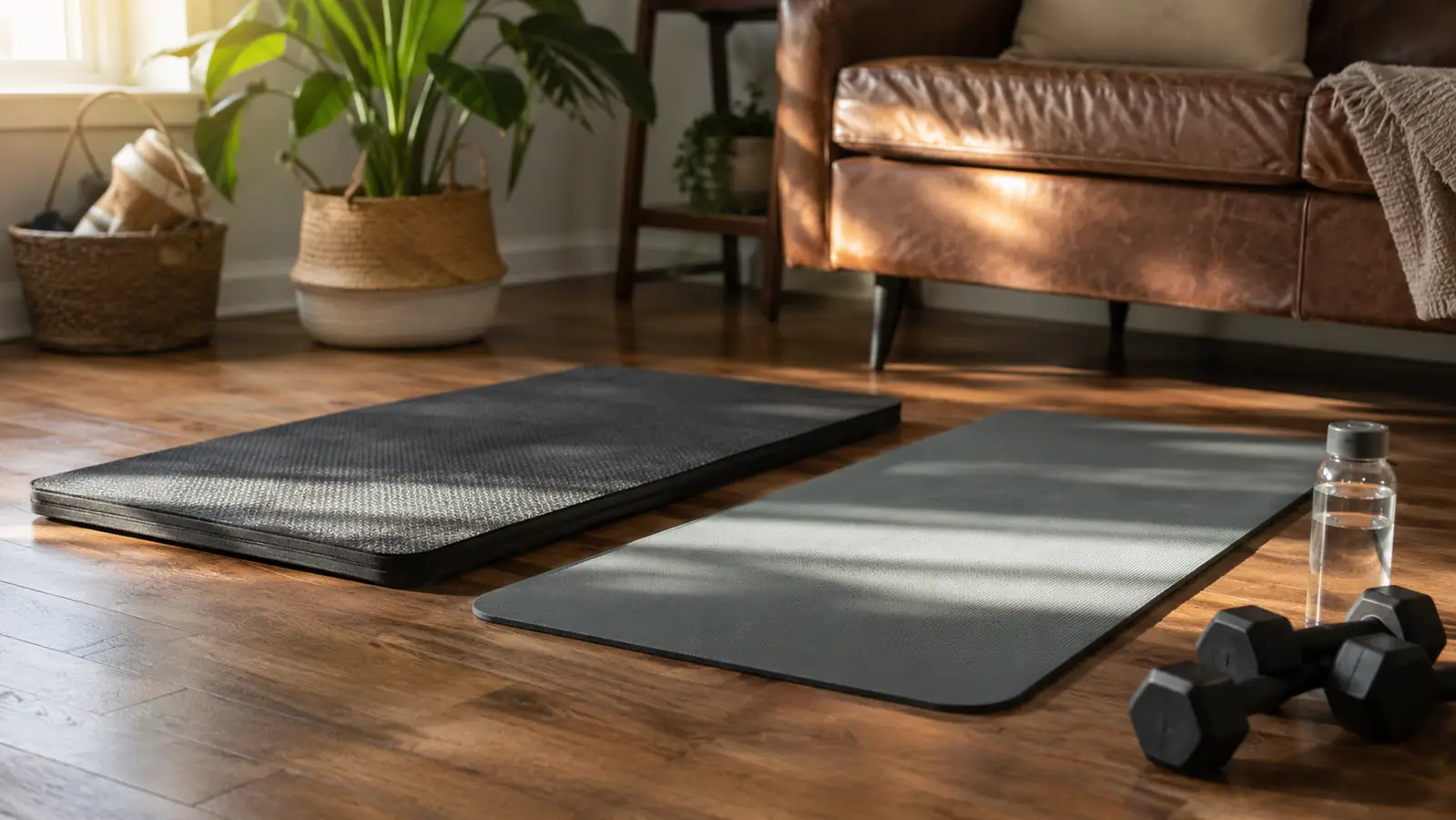
If you are setting up a home workout space and trying to decide between a thick exercise mat and a regular thin yoga mat, here is the short answer: a thick mat protects your knees, wrists, and spine during floor exercises, while a thin mat gives you the stable surface you need for balance-based yoga postures. Most people are better off with a thick mat unless yoga is the main thing they do. But that answer only helps if you know what kind of exerciser you actually are, and a lot of us are doing more than one type of workout at home.
I have owned both types over the years. My thin yoga mat sat rolled in the corner of the bedroom for months while I did floor exercises on the carpet with a towel underneath. That was my workaround until I finally bought the ProsourceFit Extra Thick Mat (the 1-inch version) and realized what I had been missing. If you exercise on hard flooring like most people do in a home setup, the difference is not subtle. The thin mat is fine for stretching for five minutes. The thick mat makes you want to stay on the floor for a full workout.
I want to be clear about something up front. This is not a review of two competing products at the same price point. A thick mat and a thin mat serve different purposes, and the right choice depends on what your home workout actually looks like on a Tuesday morning. So let us walk through the specific differences so you can decide which one belongs in your space.
| ProsourceFit Thick Mat | Standard Thin Yoga Mat | |
|---|---|---|
| Cushioning | 1/2" or 1" of high-density comfort foam absorbs impact from knees, elbows, and spine during floor work | Standard 1/8" (3mm) provides minimal padding, hard floors felt immediately through the material |
| Joint Protection | High-density foam reduces pressure on knees, wrists, and tailbone during planks, lunges, and stretches | Thin material transfers floor pressure directly to joints, users often need additional knee padding or folded towels |
| Stability for Balance | Softer surface can feel slightly unstable in standing balance poses like tree or warrior III | Firm, dense surface gives solid footing for balance-dependent yoga postures |
| Portability | Heavier at about 3 to 4 pounds, bulkier roll, comes with a carrying strap but still takes up noticeable space | Lightweight at under 2 pounds, rolls up tightly, fits in standard yoga mat bags and narrow closet spaces |
| Floor Protection | Thick foam buffers hardwood, tile, and laminate from impact during jumping jacks, burpees, and drop lunges | Thin layer offers minimal floor protection, repeated high-impact moves can scuff or mark surfaces over time |
| Best Workout Match | Floor exercises, pilates, HIIT, strength training, stretching, and anyone with joint concerns | Yoga flow, balance work, meditation, and warm-weather outdoor practice where portability matters most |
| Price | A premium thick mat with carrying strap included | A standard thin yoga mat costs noticeably less |
The One Question Nobody Answers in These Comparisons
Here is the question that tripped me up when I was shopping. Every article tells you a thick mat is better for joint protection and a thin mat is better for balance. But nobody tells you that if your workout is varied, you cannot get both from one mat. You have to pick your priority. For me, the priority was obvious once I looked at my actual routine. I do a mix of bodyweight strength, stretching, core work, and some light dumbbell exercises. About 70 percent of my floor time involves being on my knees, back, or elbows. That is a thick mat situation. I do a little stretching that involves standing balance, but not enough to justify a surface that hurts my knees for the other 70 percent.
If your routine is the opposite, if you do an hour of vinyasa flow and maybe ten minutes of supine stretching, the thin mat makes more sense. The best way to find out is to pay attention to where your body hurts after a workout. If your knees or wrists ache after floor work, you already have your answer. Do not buy a thin mat and hope it gets better. It will not.
Where the Thick Exercise Mat Wins
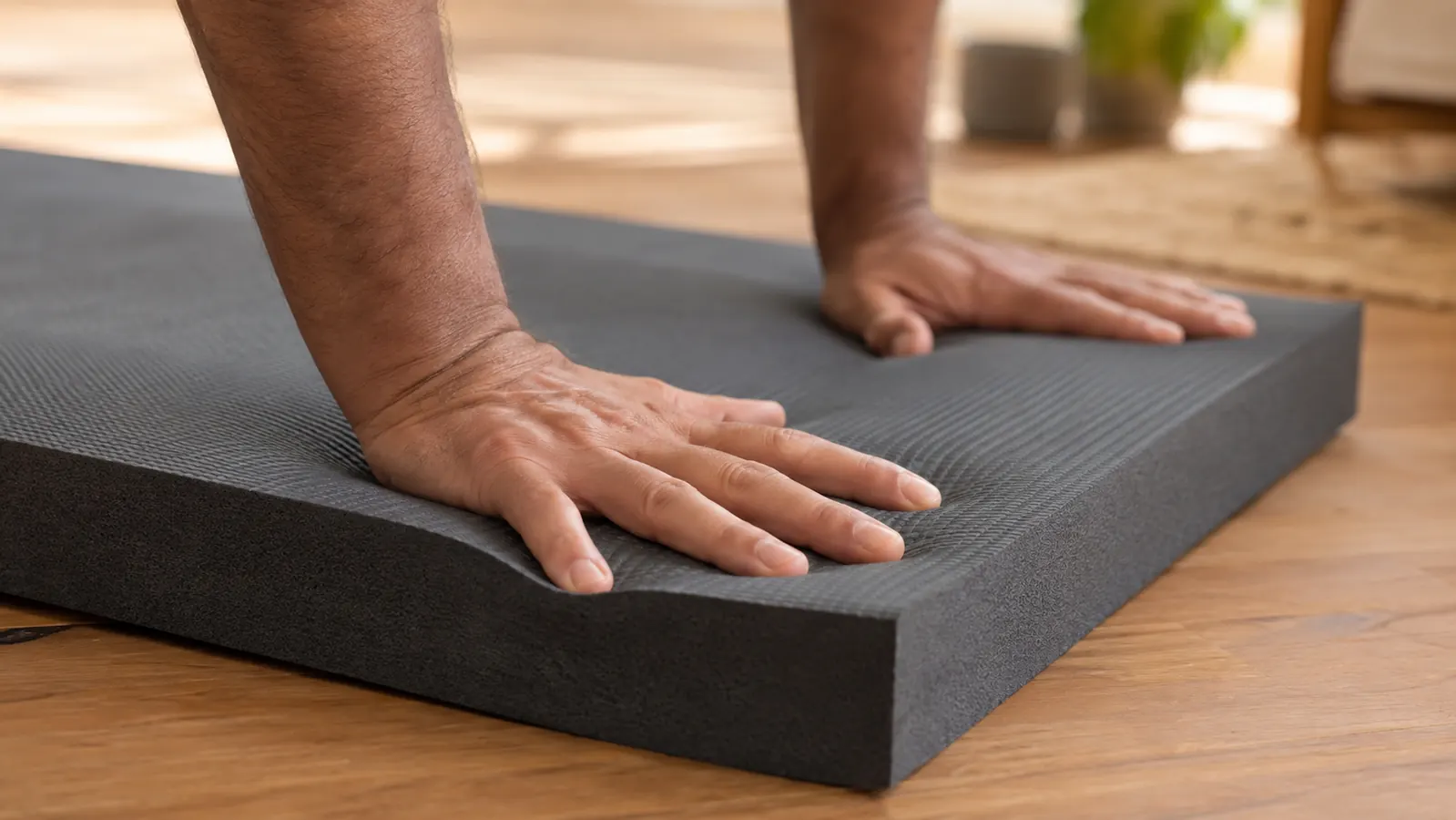
The thick mat dominates in every scenario that involves your body weight pressing into the floor. When I do kneeling hip flexor stretches, glute bridges, or supine hamstring work on my ProsourceFit mat, I do not feel the hardwood underneath at all. Before I had this mat, I was stacking towels and a folded blanket under my knees, and I still had red marks after twenty minutes. The 1-inch version I use has enough give that my knees stay comfortable through a full thirty-minute floor routine, which matters more to me now in my forties than it did ten years ago. I can actually focus on engaging the right muscles instead of thinking about how much my kneecaps hurt.
Floor protection is another category the thick mat wins outright. My workout area is in the living room over oak hardwood. Before I put the ProsourceFit mat down, I was worried about dropping a dumbbell or doing jumping jacks directly on the wood. Now I do burpees, mountain climbers, and jump squat variations without thinking twice. The mat absorbs the impact and the floor stays clean. For anyone renting or living in an apartment with downstairs neighbors, a thick mat also deadens the sound of feet hitting the floor, which is a real courtesy if you work out early in the morning before the rest of the house is awake.
The longer length is worth mentioning too. The ProsourceFit mat is 71 inches long, which is about 3 inches longer than a standard yoga mat. That extra length matters when you are lying down for a full body stretch or doing rolling exercises. My shoulders and heels both stay on the mat without me having to reposition halfway through. It is one of those details you do not think about until you have it, and then you wonder why all mats are not that long.
Where the Thin Yoga Mat Wins
The thin yoga mat has one big advantage that matters if yoga is your primary workout: stability. A thick mat with a lot of cushion makes standing balance poses feel wobbly. When you stand on one foot in tree pose or try to hold warrior III on a 1-inch foam surface, your foot sinks in slightly and your stabilizer muscles have to work harder to keep you upright. Some people actually like that extra challenge, but for the majority of yoga practitioners, a firmer, thinner surface gives you the grounded feel you want. Your foot connects directly to the floor and your balance cues come through clearly. If you practice at a studio, you already know that every studio in the country uses thin mats for exactly this reason.
Another thing I noticed after switching to the thick mat is that it retains more heat. The dense foam traps body warmth, which can be a good thing in a cold room but feels clammy during a long, slow stretch session. Thin mats breathe better and stay cooler. That might not matter for a fifteen-minute ab circuit, but if you are doing a 45-minute yin yoga practice, you will feel the difference.
Portability is the other place the thin mat wins, and it wins clearly. A standard yoga mat weighs less than two pounds and rolls into a tube about four inches in diameter. You can carry it under your arm, throw it in a duffel bag, or store it behind a door. My old thin mat lived in the trunk of my car for two years and I could pull it out for outdoor stretching or bring it to a friends house. The ProsourceFit thick mat with its carrying strap is not hard to move, but it is bulkier. If you plan to take your mat with you regularly, to an outdoor park or a friends place, the thin mat is the more practical choice by a wide margin. Also, at roughly half the price of a thick mat, a thin yoga mat is the cheaper entry point for someone who is not sure what they need yet.
My Pick: The ProsourceFit Extra Thick Mat for Daily Home Exercise
After using both types for months, I reach for the ProsourceFit thick mat every single day. The cushioning protects my knees and wrists during floor work, it saves my hardwood from impact marks, and the 71-inch length gives me plenty of room for stretching out. If you do any floor exercises at all, this is the mat that will actually make you want to get down on the ground.
Amazon Check Today's Price on Amazon →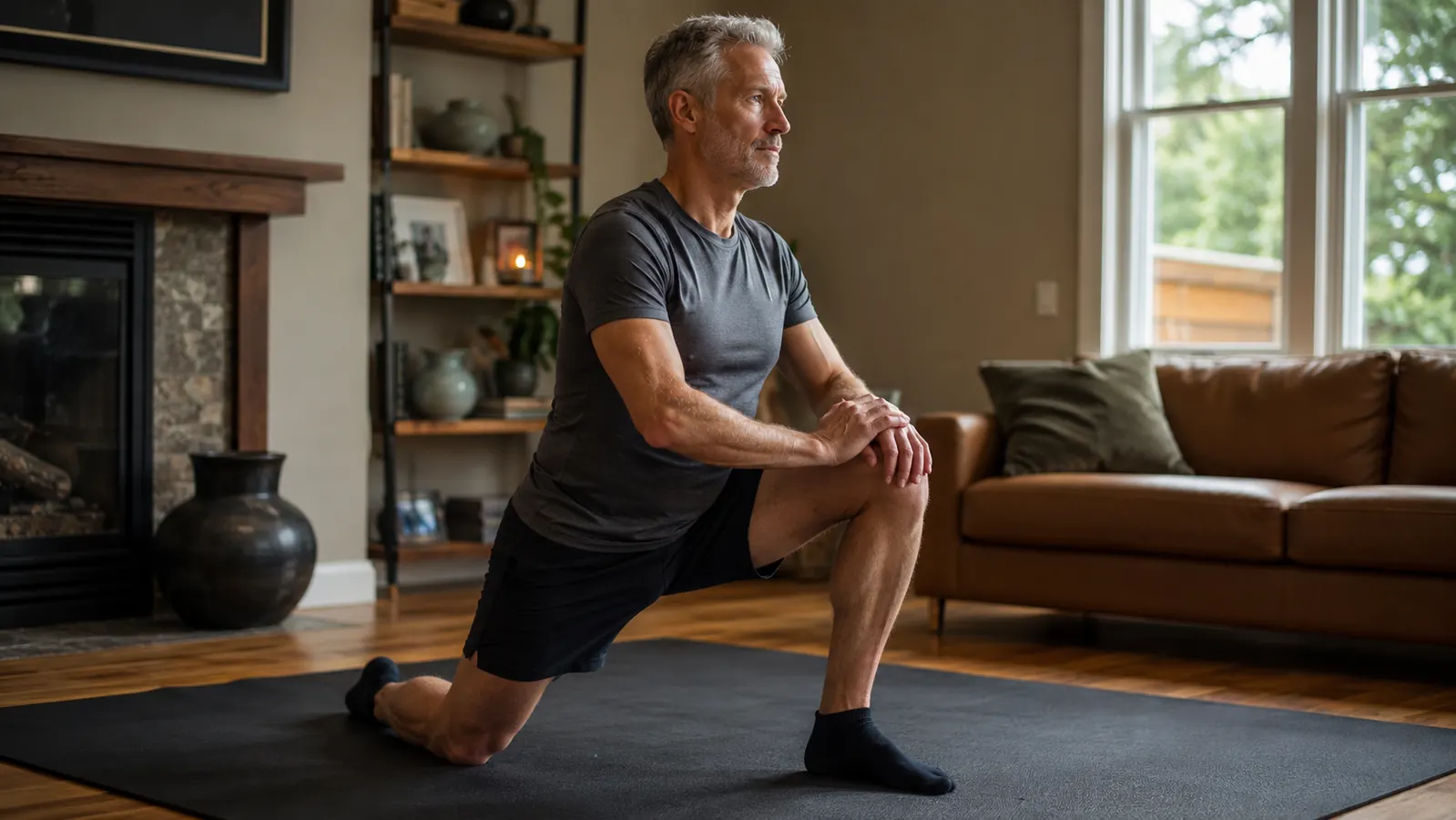
Who Should Buy Which
Buy the thick exercise mat if you do any of the following: floor exercises like glute bridges, clam shells, and leg raises; pilates or mat-based strength training; HIIT workouts with jumping and impact; stretching routines longer than ten minutes; or any workout on hard flooring. You will notice the difference the first time you kneel on it. I would also recommend the thick mat if you have existing joint issues in your knees, wrists, or lower back. The extra cushioning turns an uncomfortable workout into one you actually finish. The ProsourceFit mat specifically gives you the option of a 1/2-inch or 1-inch thickness, so you can choose how much cushion you want. I use the 1-inch and find it perfect for my needs. If you are mostly doing standing work with dumbbells or bodyweight squats, you do not need the thick mat, but it will not hurt to have one either.
Buy the thin yoga mat if your routine is almost entirely yoga-based, especially if you practice vinyasa, power yoga, or any style with lots of standing balance work. Also buy the thin mat if you need to take your mat to a studio, outdoors, or across town regularly. A thin mat is also the right call if you are on a tight budget and need something functional on a tight budget. Just know that if you ever do floor exercises like pushups, planks, or ab work on hardwood, you will feel the floor through a thin mat. That is the tradeoff, and it is an honest one. Some people solve it by doubling up a thin mat over carpet or by adding a folded towel under their knees, but that is a workaround, not a solution. Over time, the workaround gets old and you either stop doing floor work or you buy a thick mat anyway.
The honest truth is that most home exercisers end up wanting a thick mat eventually. I started with a thin yoga mat because it was cheap and available. I used it for about six months before I admitted to myself that I was avoiding floor work because my knees hurt. Switching to the ProsourceFit thick mat changed that completely. Now I look forward to the floor portion of my workout because it actually feels good. If you are reading this and already doing floor exercises on a thin mat, you know exactly what I am talking about. Your joints are telling you something, and a thick mat is the answer.
My Final Take
There is a reason thick exercise mats have become more popular over the last few years, and it is not just marketing. People doing home workouts on hard floors realized that a thin mat is not enough. The ProsourceFit Extra Thick Mat solves the real problem: making floor work comfortable enough that you actually do it. A thin mat is fine for specific use cases, but for the home exerciser doing a mix of strength, stretching, and core work on hardwood or tile, the thick mat is the better investment. Your knees will tell you which one you need. Listen to them.
Made the Call? Grab the ProsourceFit Thick Mat and Start Working Out Comfortably
A good mat changes how often you actually get on the floor and exercise. The ProsourceFit Extra Thick Mat is the one I use daily and the one I recommend to anyone building a home workout space on hard flooring. Your knees and wrists will thank you.
Amazon Check Today's Price on Amazon →